1776: Thomas Dunckerley and birth of the Provincial Grand Lodge in Essex
Bringing the history of our first Provincial Grand Lodge meeting alive to a modern audience
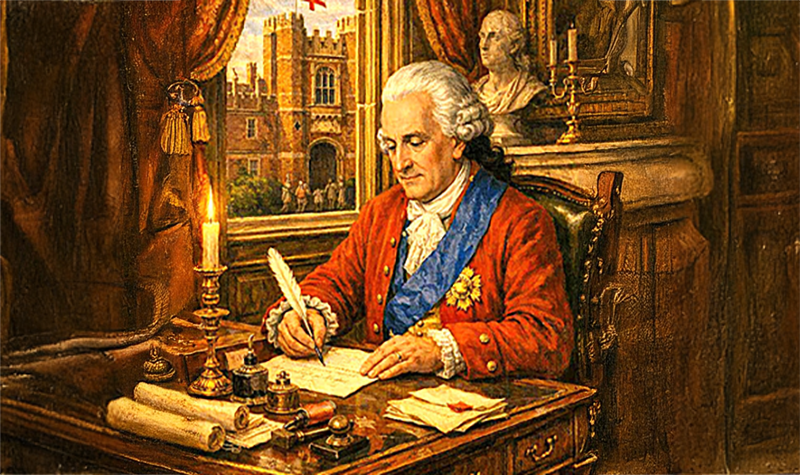
Our Provincial historian Tony Hales describes Thomas Dunckerley’s involvement with the first Provincial Grand Lodge meeting in Essex - from Royal Favour to Masonic Legacy.
Background - Nine years earlier in 1767, King George III had accepted the then 42-year-old Thomas Dunckerley as the illegitimate son of his grandfather King George II. Thomas was awarded an annuity of £800 a year, a coat of arms with the baton sinister to denote illegitimacy; and entitled to sign correspondence as Fitz George (the son of George), which he seldom used. With additional patronage from other Royals and pensions Thomas’ annual income was equivalent to about £240,000 today.
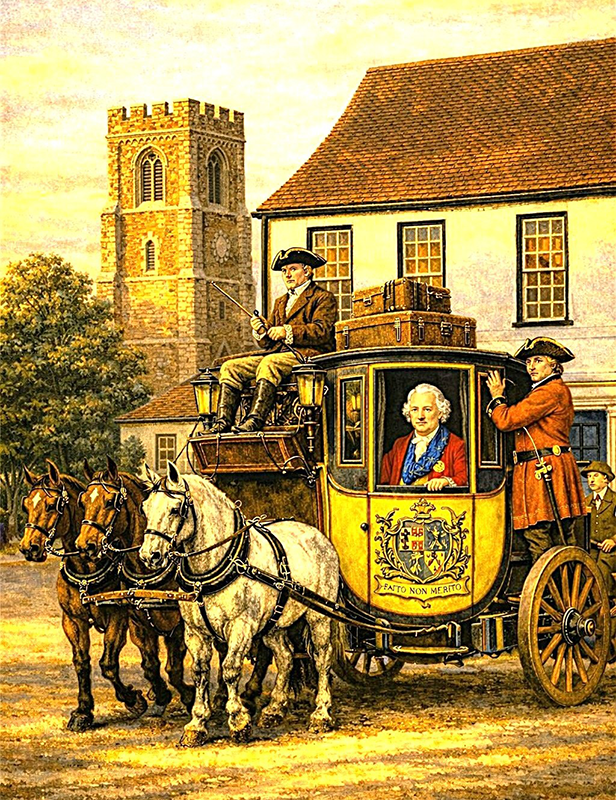
 George III also granted him an apartment at Hampton Court Palace, the former main Royal residence of George II, which was now home to several other Royals and their families as well as Thomas with his wife and daughter. With servants to look after them, Thomas would also have had his own superior quality coach suitable for long journeys complete with a coachman to drive, a groom to look after the horses and a footman to open doors and look after his luggage.
In early May 1776 - Lord Petre, the Grand Master of the Premier Grand Lodge of England, who was born at Ingatestone Hall, asked Thomas to be the Provincial Grand Master (PGM) for Essex. He knew Thomas had many years’ experience as PGM for both Hampshire and the Isle of Wight, as well as being Grand Superintendent of the original Royal Arch Grand Chapter; and that his zeal in fundraising had significantly contributed towards the cost of the new Freemasons’ Hall.
From his desk at Hampton Court Palace, and with short notice, Thomas Dunckerley wrote to the four Lodges in Essex which had been directly administered by the Grand Secretary. He invited their brethren to join him at the Dedication of Freemasons’ Hall on 23rd May. Thomas received an interesting reply from Globe Lodge, Harwich, dated 22nd May giving apologies due to short notice, additional information and a special request highlighting the intensity of feeling there was between the Ancients and Moderns at the time.
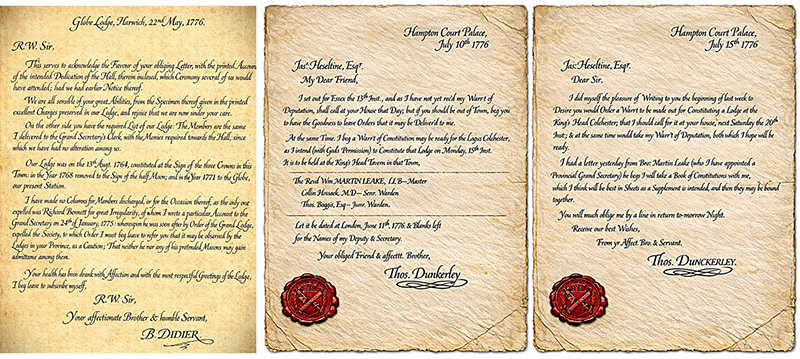
 Six weeks later in July 1776 - Thomas sent a letter dated 10th July to James Heseltine, the Grand Secretary, with his plan to constitute a new Lodge at the King’s Head Tavern, Colchester on Monday 15th. He requested both his Provincial Warrant of Deputation, which he still had not received, and asked that a Warrant of Constitution backdated to 11th June 1776 be prepared for the new Lodge.
This letter was followed with another written in stronger terms on 15th July, saying he would collect both Warrants from the Grand Secretary’s House on Saturday 20th July, and he also needed a Book of Constitutions which his new Provincial Grand Secretary had requested.
Thomas continued his journey by coach to Colchester where on or about Monday 22nd July at the Kings Head Tavern, which still stands today, he appointed Bro Thomas Boggis as his Deputy Provincial Grand Master, Bro Reverend Wiliam Martin Leake as the Provincial Grand Secretary and Bro Reverend John Firebrace as the Provincial Grand Chaplain. This was the first Provincial Grand Lodge meeting in Essex.
Thomas then constituted the Lodge of Unity No. 496 followed by Unity Chapter No. 12 for which a Chapter Charter had been granted to him, Thomas Boggis and Edmund Affleck. There were nine other members including the Reverend Wiliam Martin Leake. This was the first Royal Arch Chapter in Essex.
Illustrations:
Top: Thomas Dunckerley writing at his desk in Hampton Court Palace
Left: First panel: Letter from Globe Lodge at Harwich dated 22nd May 1776 - Next panels: Thomas Dunckerley’s letters of 10th and 15th July 1776 to the Grand Secretary
Right: Thomas Dunckerley arriving at the Kings Head, Colchester. In the background is St Mary’s Church tower famous for the poem ‘Humpty Dumpty’ from the 1648 siege of Colchester in the English Civil War